There are moments when I feel rather torn. In one corner of my brain my medieval characters are clamouring for my attention, in another, 17th century Matthew and his wife Alex are just as vociferous (with some reason: I’ve sort of left them hanging) In my frontal lobe my new characters are spreading out, and as I have three WIPs in various stages of completion this means I have one group of contemporary protagonists, another set of (new) 17th century characters among which figures a certain Queen Kristina of Sweden, and a new medieval set. My new medieval set is presently snagging a lot of attention – Edward I is a commanding presence, even when relegated to a supporting role.
“Supporting role?” Edward’s droopy eyelid twitches.
“Yup.” I give him an ingratiating smile. “If not, you’d take over the entire narrative, sire.”
“Hmm.” He doesn’t look convinced and gives Robert FitzHugh a rather dark look. I give Edward a warning scowl. “This is MY brain,” I remind him. “If you don’t behave, poof, and you’re gone.”
The tall king smirks. “You think?” He shakes his head. “I am a conqueror at heart, fair authoress. Where I want to go, I go.”
I forgive him for his condescending tone because of his indirect compliment—and because I do need him to stick with the project. He may not be the protagonist, but he’s the “real-life” character my story pivots around.
I do that a lot: I use real peeps to anchor my make-believe to a historical period. I prefer fictional protagonists, but they become far more solid when they hover round someone who did exist, their lives affected by what this real person did or didn’t do. In Edward I’s case, it’s his obsession with Wales that sits at the heart of my plot. In my series The King’s Greatest Enemy, it’s the final fate of Edward II—and of Roger Mortimer and Queen Isabella—that set the boundaries for my story. Within those boundaries, I subject my Adam and his Kit to a lot.
If we leap ahead to the 17th century and Matthew and Alex, one of my more joyous discoveries was a certain Alexander Peden. I had been reading up on the persecution wreaked upon the Scottish Presbyterians after the Restoration of Charles II (this relatively tolerant gent had little time for the members of the Scottish Kirk, probably a result of how he was treated by the Scots in 1650 when, as a newly crowned king of Scotland, he was dragged hither and dither as it pleased his Scottish lords) and had just realised that the little town I’d chosen as closest to Matthew’s beloved Hillview, Cumnock, had been the home of a most fiery and determined Scottish minister, nalemly Alexander Peden.
As a consequence, Alexander (or Sandy to his friends, among which I now count myself) came to play a pivotal role in the third of the books, The Prodigal Son. His was a cloak-and-dagger sort of life, always on the run from the English who wanted nothing more than to apprehend him and send him off as indentured labour to the West Indies. Eventually Alexander was captured, betrayed for the very generous prize on his head. Fortunately for him, the attempt to transport him failed utterly.
In one of my WIPs, Queen Kristina of Sweden plays an instrumental role. So far, this WIP is taking one step forward and two back, mainly because I can’t quite decide whether I like Kristina or not. I lean towards the not – the lady held a very high opinion of herself. At the same time, I admire her for being a big,big girl in a man’s world. Thing is, until I’ve made up my mind, poor Sofia Carolina (very much a figment of my imagination) can’t exactly make up hers either.
“Some days I like her, some days I don’t,” Sofia tells me. “Thing is, even when I don’t like her, I still care for her.”
True. So do I, because Kristina’s childhood was no child’s play, surrounded as she was by a wacky mother and serious gents who constantly reminded her of her duties to the state. As she herself said, “any child born to inherit the crown belongs to the state”.
I shall have to make up my mind about Kristina later. At present, I am more concerned with Edward I. As multi-layered as an onion, that man is.
“Ah. You find me enigmatic?” the king asks with a little smile.
“I find you contradictory,” I retort. “On the one hand a loving husband, a good lawmaker, on the other a brute.” Oops. Shouldn’t have said that. He is fading away fast, and I must throw myself forward to grab hold of him before he totally disappears. “Stay and prove me wrong,” I tell him.
“I can’t.” He glares at me. “Things were complicated back then.”
Well, clearly my Edward I will have moments when his conscience pricks him. That, IMO, is good.

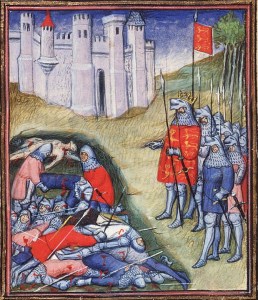 Was he a perfect king? I suspect the French would have replied with a resounding NO. After all, Edward III unleashed the Hundred Years’ War on France, resulting in far too much death, too much loss. He was ruthless in war—whether in France or Scotland—but he was also a man determined to act honourably towards his vanquished foes. Well…if it suited him politically.
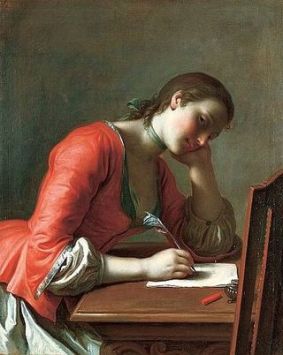 “No inspiration,” I sometimes sigh, while staring at the screen which remains enervatingly blank. And yes, inspiration is a must when it comes to writing—if nothing else as the igniting spark—but there’s another component which is just as important: discipline.
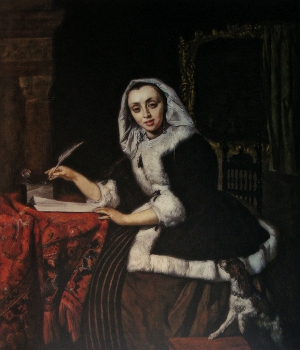 I think this is my favourite phase of the writing process, lovely hours spent polishing my work. This is also when I discover that perfect scene in which my heroine is staring out towards the setting sun has to go as the location she’s at would not offer all that much of a view to the west. I sigh mightily at having to cut the scene—but pat myself on the back for having the fortitude to do so. After all, facts are facts.
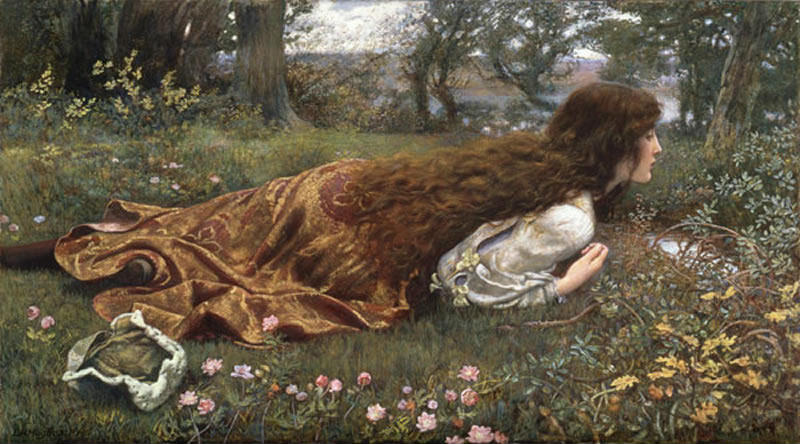 I was eleven. It was more or less midnight and I snuck out of bed and opened the door to my closet. I clambered up the fitted shelves to the little platform right at the top – my secret nest. The closet was – obviously – dark. It smelled of wood and clean clothes. I struck a match and lit the seven candle stumps I’d arranged in a rough pentagram shape. I put on my home-made tunic. As I am a disaster at sewing, it was stapled together. A belt, my Dad’s heirloom knife and I was ready to go. I swept my hands through the respective flames, set my palms flat to the wood and prayed for time to tear itself open and suck me through, land me at the feet of my great hero, Richard the Lionheart.
 Wandering through the past has similarities to walking through the forest on a summer night. There is enough light to make out the general shape of things, the odd boulder, the stand of rustling oaks. The water of the distant lake shimmers in the ambient light, and a streak of orange hovers to the west – enough to illuminate the general contours that surround you.
 timelightcom